Everything the kitchen and the office need in one place — so your numbers keep themselves current and your consultants work from the truth, not a stale spreadsheet.
Cost every dish to the plate; food-cost % against your target updates as ingredient prices move. Import a whole menu from CSV or your POS.
Food + labor, the metric operators actually manage — rolled up across the day, week, or month.
Food cost says what a dish costs to make; this says what it earns. Rent, wages, utilities and marketing come down to the plate from your own P&L, two ways — as a share of the dish’s price, and evenly across covers. A $6 side can clear 15% one way and lose money the other, and every dish that flips is flagged. That is where the pricing decision sits.
A question in plain English — “which ingredient is losing me the most money?” — answered from your own reports, with the table, the chart and the workings attached. It runs the same costing code the screens do, so the answer and the report cannot disagree. And it respects who is asking: a line cook cannot get the payroll line out of it.
What left the store room, against what the recipes can account for. Counts in, purchases in, and the gap named per ingredient — worst first. Yield is not counted as waste; expected trim is already in the plate cost.
Purchases, physical counts, waste and transfers in one log, each booked in its own unit and converted to what the ingredient is costed in.
A photo of a receipt, a PDF invoice, or the vendor’s own spreadsheet. The spreadsheet never goes to a model: it is asked only which column holds the name and which the price, and every row is then read in code — so no quantity or cost in your price list can be invented. A line that appears twice is flagged before it posts, one invoice cannot create the same ingredient seven times, and a late-arriving older invoice cannot quietly undo a price you already have. Every cost carries the date it was last seen, so you can tell a current number from one nobody has checked since spring.
What each supplier charges for the same ingredient, converted to the unit you cost it in, at each vendor’s latest price rather than an average nobody can buy at. Ranked by what switching would actually save, with spreads too small to be real — rounding, freight — kept off the list.
Cost a pour the way you cost a plate — spirits by the litre, beer by the keg, wine by the glass, with the mixed-beverage and TABC deadlines already on the calendar. Count the bar and the usage report tells a free pour apart from foam and line loss: same overage, different problem, different fix.
Daily to yearly, on a restaurant chart of accounts, down to net. Food cost auto-syncs from sales. Export to PDF.
Cash, inventory and retained earnings auto-derived; the rest you enter. Balance check + PDF.
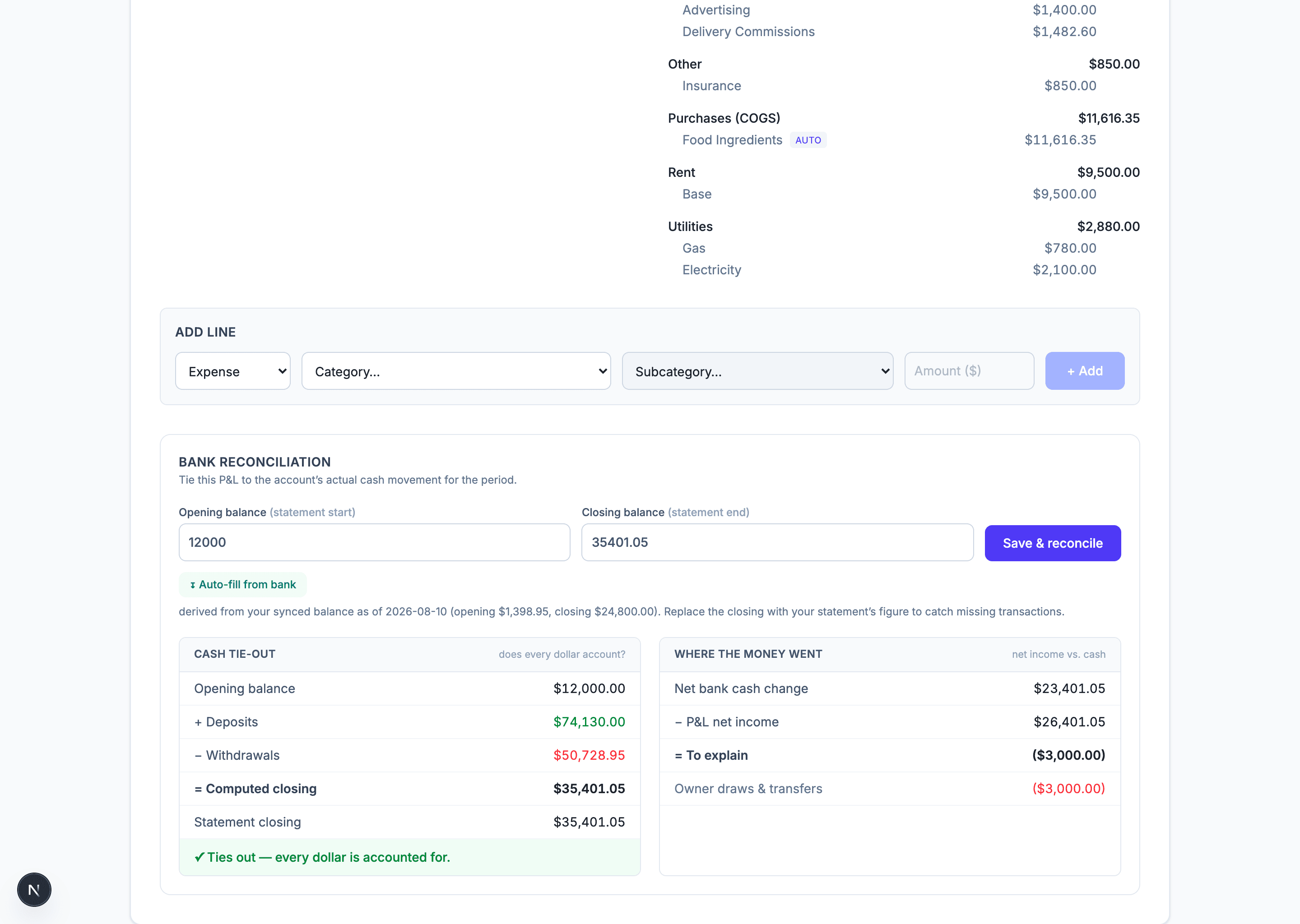
Tie the P&L to real cash via Plaid — a completeness check and a where-the-money-went bridge.
Pull sales and sync your menu from Square, Toast, Clover or Shift4 Dine; import ingredients, menu and recipes from CSV in minutes.
Group stores under one org, bill per location, and see prime cost across the whole portfolio, worst-first.
Owner, manager, staff and viewer roles, enforced on every request. Line cooks never see the P&L.
Tax, payroll, fire, facility and licence deadlines with the lead time each needs, plus a weekly reminder. Set your own due date on any item where yours differs from the standard one — the bookkeeper who closes early, the pest contract written for 60 days. Federal items apply anywhere; the state and city items are Texas today — tell us your state and we'll add it.
Lock our own support team out of your account. Access is granted by you, time-boxed, and written to a log you can read and neither of us can edit.
Professional PDFs of the P&L and balance sheet for your bank, partners or lender.
Income and expenses on a real restaurant chart of accounts, with food cost pulled straight from sales and prime cost front and center. Draft it, lock it, export it.
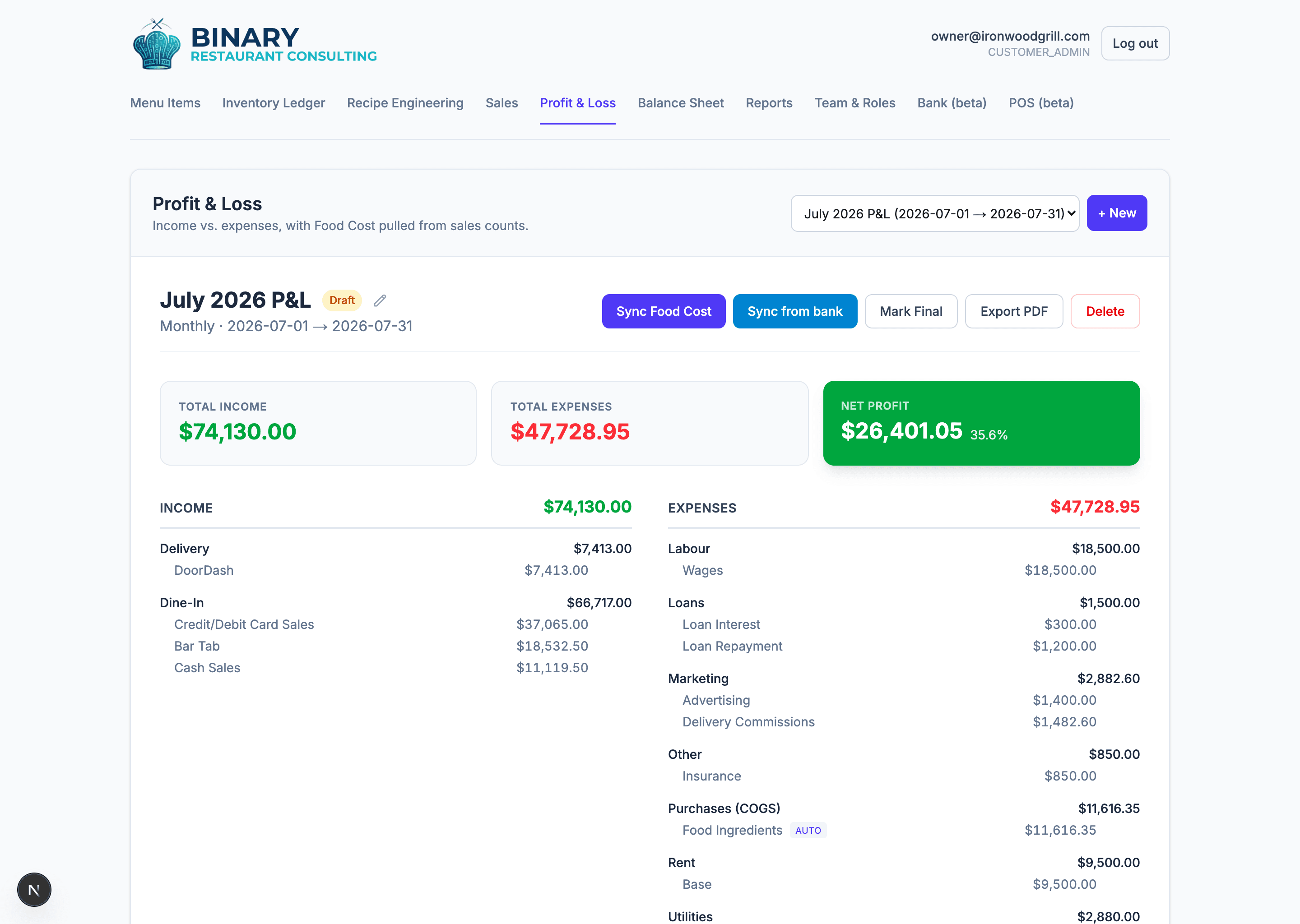
Net income is never your change in cash. We tie the P&L to the bank and show the gap in plain English — owner draws, loan principal, inventory timing.
A 30-minute walkthrough with your food cost, prime cost and cash — live.